Su Vista Marketing For Roofers
Marketing For Roofers By Roofers

Off Page SEO for Roofers: How to Build Trust Beyond Your Roofing Website
A strong website design helps, but it is not the only thing that affects how a roofing business performs in search. Homeowners also judge your reputation through Google, reviews, directories, community mentions, and other local signals. That is why off-page SEO is a major part of roofing SEO for companies that want more calls, better visibility, and stronger trust.
Off-page SEO is the work done outside your website to improve how customers and search engines view your business. For roofing contractors, that includes backlinks, reviews, local citations, Google Business Profile activity, and trusted mentions on other websites. These signals help Google understand that your roofing business is real, active, and connected to the local market.
On-page SEO can give you a better website structure, but off-page can give you the outside proof needed to compete. If a competitor has better reviews, stronger backlinks, and more local mentions, they may earn more visibility even when your page content is similar.
Why Off-Page SEO Matters for Roofing Companies
Off-page SEO matters because Google does not only look at what your website says about your business. It also looks for outside signals that support those claims. If your site says you are a trusted roofing company, Google wants to see whether other websites, customers, directories, and local sources seem to agree.
For roofing contractors, those outside signals can come from several places. A backlink from a manufacturer directory can show that your company is connected to a recognized product line. A chamber of commerce listing can connect your business to the local community. A steady flow of detailed reviews can show that real homeowners have hired your team and had a good experience.
These signals work together to support local SEO. They help Google understand where your business operates, what services you provide, and how trustworthy your company appears compared to other roofing businesses in the same market. Over time, this can improve organic visibility, strengthen your ranking potential, and help your business get more leads from search.
How Google Reads Outside Trust Signals
Google uses many factors to judge a website. Content, technical setup, and keywords matter, but off-page signals help confirm whether a business deserves attention. Another trusted website linking to yours is building your roofing company’s reputation.
A backlink from a manufacturer, supplier, trade group, local chamber, or respected local organization carries more value than a random directory. Quality matters more than volume. A few relevant backlinks can help more than dozens of weak links.
For local SEO, consistency also matters. Your name, address, phone number, service area, and Google Business Profile should match across important websites. Clean information helps Google connect your roofing company to the right local market.
Backlinks and Link Building for Authority
Backlinks help build authority because they show that other websites trust your content. For roofers, the best sources are usually connected to the industry or the local community. Manufacturer pages, supplier listings, association directories, sponsorship pages, and local media mentions can all support roofing SEO.
Link building should never be treated like a shortcut. Buying cheap links or using spammy websites can damage your backlink profile and create risk. Good link building is based on relevance, relationships, and useful content.
Roofing companies can earn backlinks by publishing helpful guides, supporting community events, joining trade organizations, sharing project stories, and building partnerships. These efforts create real reasons for other websites to mention your business. For example, a roofing contractor may earn backlinks from a shingle manufacturer’s certified contractor directory, a local builder association, a roofing supplier, a chamber of commerce, or a community sponsorship page. These links make more sense than random links from unrelated websites because they connect the business to the roofing industry or the local service area. Google is more likely to trust signals that match what the company actually does.
Local SEO and Google Business Profile Strength
Local SEO is critical because most homeowners search for roofing help close to home. They may need roof repair after a storm, a roof replacement estimate, emergency leak service, or help with a specific roofing material. When they search, Google decides which companies appear in the map pack, local listings, and organic results.
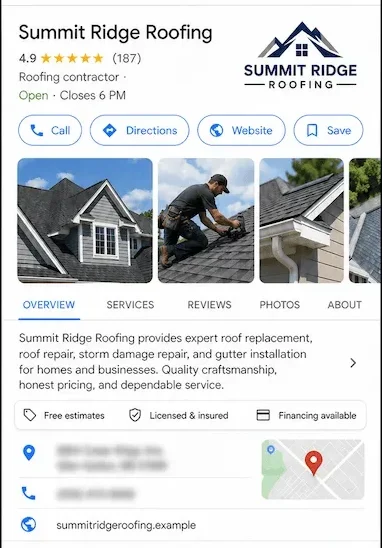
Your Google Business Profile plays a major role in that decision. It should clearly show your services, service areas, hours, photos, reviews, contact details, and recent updates. A complete and active profile helps Google understand what your company does, where you work, and whether your company is still active in the local search market.
Local SEO depends on relevance, prominence, and proximity. You cannot control how close every search request is to your office, but you can improve how relevant and trustworthy your company appears. Detailed service descriptions, strong reviews, fresh project photos, accurate information, and trusted local mentions all help build that outside proof.
For roofers, this matters because homeowners often compare companies before they ever click a website. A roofing business with recent reviews, clear photos, accurate services, and a strong GBP will usually look safer than a company with thin information or outdated activity. That trust can turn local visibility into real calls, form submissions, and booked estimates.
Online Reviews Help Turn Visibility Into Calls
Online reviews are one of the most practical trust signals for a roofing business. They help customers decide who to call, and they can also support local SEO. A company with recent, detailed reviews usually looks safer than one with old or thin feedback.
The quality of each review matters, too. A short review that says “great company” is helpful, but a detailed review carries more weight with homeowners. When a customer mentions the type of roof, the problem, the location, the crew, the cleanup, or the result, that review gives future customers more confidence. It also gives Google more context about the services the company performs.
Roofers should also have a steady review process. Ask after clean repairs, completed replacements, helpful inspections, and strong customer experiences. A consistent process helps your business improve leads because trust is built before the first phone call.
Local Citations and Community Proof
Local mentions can increase visibility. A mention on a chamber page, sponsorship page, school fundraiser page, nonprofit site, supplier page, or neighborhood feature can help connect your brand to the area you serve.
This matters because roofing is often decided by familiarity. Homeowners are more likely to call a contractor they have seen before. A stronger local footprint can help your business stand out when customers compare options in your city.
Local SEO works better when your company looks active in the real world. Community involvement, partnerships, and local recognition all support authority. They also make your marketing feel more believable.
Promoting Content Beyond Your Roofing Website
Publishing blogs is helpful, but publishing alone is not enough. A strong guide should be shared, referenced, and reused across other marketing channels. That is how content starts making your website more visible.
A storm damage article can be shared with real estate agents, insurance contacts, neighborhood groups, and property managers. A maintenance guide can support email marketing, social posts, and partner outreach. These efforts can create traffic, mentions, and backlinks.
This approach supports organic growth because your content becomes useful outside your website. It also helps Google see that your roofing website deserves more visibility in search.
What a Strong Off-Page SEO Strategy Should Include
Clean up your main directory listings, improve your Google profile, build a review system, and check your backlinks. Then look for better opportunities through partnerships, PR, sponsorships, and local outreach.
The strategy should connect roofer SEO, local SEO, content promotion, and reputation management. It should also track ranking movement, calls, forms, visibility, and organic traffic. Marketing is easier to improve when the business knows which actions are actually working.
Track the Signals That Lead to Real Roofing Leads
Off-page SEO should be measured by more than rankings. Rankings matter, but they do not tell the full story. A roofing contractor should also track GBP calls, direction requests, website clicks, form submissions, branded searches, review growth, referral traffic, and leads from directory listings. Being listed on every low-quality site is not the goal. Being listed accurately on the right platforms is what matters.
A good SEO strategy should make the roofing company easier to find, easier to trust, and easier to contact. If the work is not helping those three things, it needs to be adjusted. It should not rely on one tactic. That combined approach helps a contractor get more clients without depending only on paid ads.
Common Off-Page SEO Mistakes to Avoid
Many contractors focus only on their website and ignore outside proof. That creates a weak foundation. If your competitors have more reviews, better backlinks, and stronger local authority, they may keep winning search results. More is not always better. Relevance, trust, and consistency matter more than raw volume.
Some companies also ignore keywords when building outside listings and mentions. Your services should be described clearly so customers and Google understand what you offer. Use natural keywords, not stuffed phrases. Just as maintenance is important to a home roof, SEO reports are important to check the strength of your current SEO strategy. SEO reporting can help you see which areas are successful and which are in need of improvement.
Building a Roofing Site in Trust
Off-page SEO is not optional if you want durable roofing SEO. Your website needs strong content, but your business also needs outside proof that supports what your site says.
For roofing companies, the best strategy includes better reviews, stronger backlinks, accurate listings, active Google management, and deeper local visibility. These signals build authority, strengthen search performance, and help turn attention into real leads.
When done correctly, off-page work gives your business a stronger edge in a crowded market. It helps homeowners find you, trust you, and choose you when the roof problem becomes urgent.
Free Strategy Call - Book Today
You will walk away with a plan for how to grow to the next level for your company.