Su Vista Marketing For Roofers
Marketing For Roofers By Roofers

Roofing SEO Keyword Research Tips That Bring in Better Leads
Getting found online starts long before a page is written. It starts with picking the right keyword targets for your market, your services, and the kind of customer you actually want. Too many roofing companies build pages around phrases that are too broad, too competitive, or too disconnected from what homeowners are searching when they are ready to call.
A smart keyword strategy helps you stop guessing. It gives your website direction. It helps shape your service pages, location pages, blogs, and internal linking. More importantly, it helps your roofing company show up for searches that lead to real jobs instead of random traffic.
If you want better results from roofing geared SEO, the goal is not to chase every phrase with high numbers. The goal is to match your website to the right searches, the right pages, and the right buyer intention.
Free Strategy Call
You will walk away with a plan for how to grow to the next level for your company.
Start With Roofing Keywords People Actually Search For
One of the biggest mistakes in researching keywords is building a plan around industry language instead of customer language. Homeowners are not always typing in technical phrases. They are usually searching for practical help. That means your starting keywords should be your core services.
For most companies, that includes keywords tied to repair, replacement, inspections, leaks, storm damage, and emergency work. These are often the highest-value topics because they line up with real demand. A homeowner dealing with a leak is not browsing for fun. They need help now.
That is why repair terms matter so much in marketing for roofers. A strong roofing site should usually have a dedicated page for roof repair, plus related pages that support it. If your market has demand for emergency work, storm damage, or leak issues, those topics deserve their own webpages as well. Grouping everything under one page often weakens your overall SEO strategy.
Use Real Lead Data Before Expanding Your Keyword List
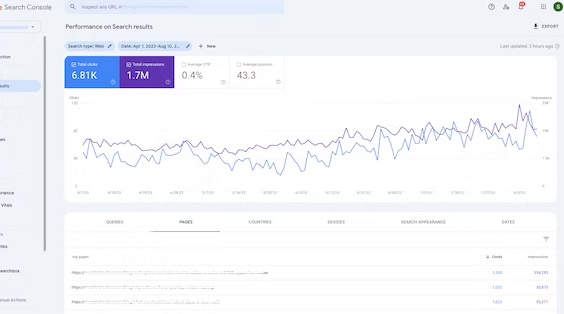
One of the smartest ways to improve SEO driven keyword research is to start with the jobs your company already gets. Too many roofing businesses jump into keyword tools before looking at their own data. That is backwards. Your calls, estimate requests, sales notes, and Google Search Console queries can reveal which services people already associate with your company and which searches are most likely to bring in real leads.
This matters because not every roofing service has the same value. A company may get more searches for one topic, but better jobs from another. If roof repair, storm damage, metal roofing, or commercial leak work tends to produce stronger revenue or better close rates, that should shape the keywords plan. It is about what kind of search turns into profitable work.
Separate Broad Terms From Buyer-Ready Terms
Not every roofing keyword deserves the same priority. Some searches are broad and educational. Others are much closer to a lead. Learn the difference to increase marketing leads.
For example, general roofing terms may help you attract early-stage visitors. Those phrases can work well in blog content or supporting articles. But service pages should focus more on buyer-ready searches. That is where transactional keywords come in. These are the phrases people use when they are actively looking for a contractor, pricing, or service in their area.
A phrase like “how long does a roof last” serves a different purpose than “roof repair near me” or “roof repair in Baltimore.” The first is educational, so Google is more likely to favor blog content that answers the question clearly. The others show stronger service intent, which means Google will usually lean toward service pages, location pages, and map results. When those keywords get mixed onto the wrong pages, rankings can suffer and multiple pages may start competing against each other instead of working together.
Build Around Local Roofing SEO Behavior
Most SEO roofing leads come from local searches, not national traffic. That means your strategy needs to reflect how people search in your service area. In many cases, they combine a service with a city locale, county, neighborhood, or nearby landmark.
That is why local SEO matters so much for roofing companies. Your pages should reflect the way local customers search, not just the way you talk about your business internally. A roofing company in Maryland may need pages for roof repair in Columbia, roof repair in Bowie, and roof repair in Annapolis if there is enough demand and those are real service areas.
In some cases, adding the state to a page can make sense, especially when users search broader regional phrases. But the strongest local pages are usually built around a service plus a specific location. Service keywords help search engines connect your page to local search and service relevance.
Use Tools, But Do Not Let Them Make Decisions for You
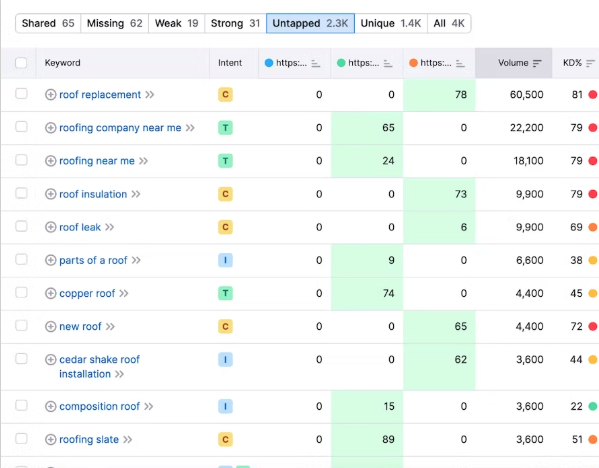
Keyword tools are helpful, but they should support your thinking, not replace it. Platforms like Moz, Google Keyword Planner, and other programs can show search volume, variations, and related phrases. That data is useful, but it has limits. Sometimes the numbers are rounded. Sometimes they miss how real people phrase a search. Sometimes they overvalue broad terms that do not convert.
Use data as a guide, not as the final answer. A phrase with lower search volume can still be the better target if it matches strong buyer interest and fits your service page better. In roofing SEO, relevance often beats raw volume.
A good rule is to compare phrases, look at the actual search results, and ask what kind of page Google is rewarding. If the top keywords are all service pages, you probably need a service page. If the top results are all blog articles, then a roofing blog may be the better fit.
Pay Attention to Search Intent Before You Write
Search goals should shape every page you build. This is one of the most overlooked parts of researching keywords. A lot of roofing companies find keywords, assign them to pages, and start writing without checking what users actually want from that search. That creates weak content and poor rankings.
Before targeting a keyword, search it yourself. Look at the pages’ ranking on page one. Are they homepages, service pages, city pages, or blog posts? Are they from a roofing company, directory site, or national publisher? That tells you what kind of content Google believes matches the goal behind that query.
This matters a lot for phrases around roof repair. Some searches may call for a broad roofing service page. Others may justify a more focused page about flat roof repair, emergency roof repair, or leak repair. Strong roofing SEO keywords are not just phrases with traffic. They are phrases that match a page type, a business goal, and a searcher need.
Create a Clear Roofing Plan for the Whole Site
A lot of roofing websites underperform because they have no structure.
- Pages get written as ideas come up.
- Topics overlap.
- Multiple pages target the same phrase.
- Important services get ignored while weaker blog topics pile up.
That is why every roofing contractor needs an SEO keyword plan. Your plan should assign one primary keyword to each main page, along with secondary variations that support the topic naturally. A homepage may target broader roofing terms and branded positioning. Service pages may target high-intent service phrases. Location pages may combine core services with city modifiers. Blog topics can target informational searches that support your main services.
This keeps your information focused and helps prevent cannibalization. It also makes future growth easier because you are building with structure instead of reacting month by month.
Create a Keyword Map to Direct Users
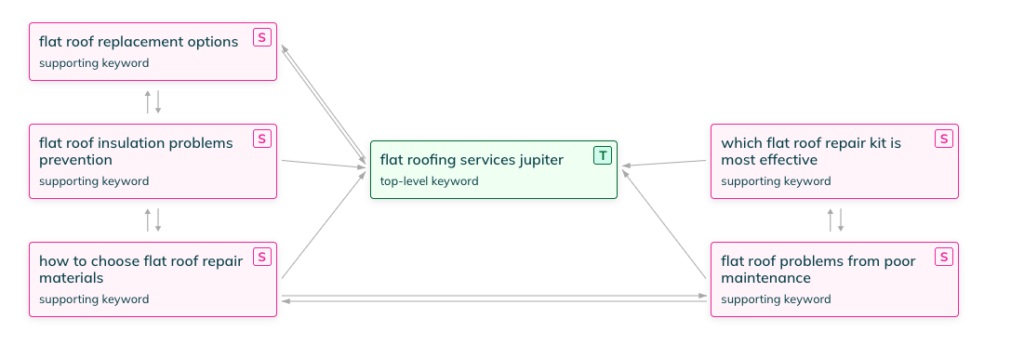
Once you have your keywords list, turn it into a keyword map. Keyword mapping is simply a document that shows which keywords belong to which page. It does not need to be fancy. It just needs to be clear.
A strong map usually includes your homepage, main service pages, subservice pages, city pages, and blogs. It may also include title tag direction, internal linking notes, and priority level. That makes it easier to hand off to a writer, designer, or developer without losing the strategy.
For example, one page may focus on roof repair, another on storm damage, another on commercial roofing, and another on a city-specific roofing service. If two pages are both trying to rank for the same keyword, one of them usually ends up weaker. Clear mapping solves that problem before it starts.
Do Not Ignore Supporting Roofing Content
Service pages do the heavy lifting, but supporting content still matters. Good content helps expand topical relevance, answer homeowner questions, and strengthen internal linking opportunities.
For roofing companies, useful content might include articles about storm damage signs, repair vs. replacement decisions, leak causes, insurance questions, or maintenance tips. This type of content supports your core service pages while giving you more ways to show expertise.
It also helps your marketing work harder over time. A strong article can rank for helpful queries, bring in early-stage visitors, and funnel them toward conversion pages later. That is especially useful when your roofing company wants to build authority in a competitive market.
Use Question-Based Keywords to Support Your Main Services
Not every good roofing keyword needs to become a main service page. Some of the most useful opportunities come from the questions homeowners ask before they are ready to book. Searches like how much roof repair costs, whether insurance covers storm damage, how to tell if a roof leak is serious, or whether a roof needs repair or replacement can all support stronger SEO when they are used the right way.
These question-based topics work best as supporting articles or FAQ sections tied to your core service pages. They help expand topical relevance, create internal linking opportunities, and bring in people earlier in the decision process. They also make the site more useful. When a roofing company answers real questions clearly, it builds trust before the customer ever picks up the phone.
Look Beyond Volume and Think SEO Value
A lot of people get stuck chasing high numbers. They see a big keyword and assume it should be the top priority. That is not always true. A phrase with lower monthly traffic may still drive stronger leads if it reflects urgent need. This is especially true with service-driven searches like roof repair, leak repair, or storm damage terms. In many cases, those phrases outperform broader roofing keywords because the person searching is closer to booking.
Your strategy should weigh opportunity, competition, relevance, and conversion potential together. That is how keyword research becomes a real business asset instead of just an SEO exercise.
Keep Technical Structure in Mind
Keyword targeting is not only about writing. Your site structure matters too. If pages are buried, disconnected, or poorly organized, your rankings can suffer even with solid content.
Make sure key pages are accessible from the main navigation or service hubs when appropriate. Support them with internal links from relevant content. Keep your sitemap clean and updated. Build category relationships that make sense for both users and search engines.
This is where a full SEO strategy starts to come together. The right keywords, the right pages, and the right structure all support each other. If one part is weak, the whole system becomes less effective.
Review Competitors, But Do Not Copy Them Blindly
Researching competitors can help you spot gaps, but copying another roofing company word for word is lazy and usually ineffective. The better move is to study what roofing keywords top competitors are targeting, how their pages are structured, and where they may be weak.
Maybe other roofing companies in your area have pages for roof repair but no strong city pages. Maybe they have service pages but weak educational content. Maybe their website has decent on-page SEO but poor trust signals or weak backlinks. Those gaps can shape your own strategy.
The goal is not to imitate. The goal is to find openings and build something more useful, more focused, and more complete.
Keep Revisiting SEO Keywords
Targeting roofing keywords is not something you do once and forget. Search behavior changes. Your services expand. New competitors enter the market. SEO rankings shift. That is why research should be ongoing.
Review performance regularly. Look at which pages are gaining traction, which keywords are stuck, and where new opportunities are showing up. Sometimes a page needs stronger blogs. Sometimes it needs better internal links. Sometimes the targeted keywords need to change.
The roofing companies that improve over time are usually the ones that treat keyword work as an active part of their marketing, not a one-time setup task.
Keyword Strategy for Roofing SEO
Strong roofer SEO starts with researching relevant keywords, not random page creation. When you choose the right keyword targets, map them to the right pages, and match them to real search goals, your website becomes much more likely to rank and convert.
The best results usually come from a simple approach done well. Focus on the services people actually search for. Build pages around local demand. Keep your content aligned with your target. Use your data to guide decisions, but do not let applications make them for you.
That is how roofing companies build a cleaner strategy for SEO , a stronger website, and a better path to real leads.
Roofing SEO Works Better When It Is Built on Strategy
Strong rankings do not come from guessing which roofing keywords to use. They come from building a clear SEO driven strategy around search goals, local demand, site structure, and the roofing services your company actually wants to sell. That kind of planning helps roofing companies avoid wasted pages, weak targeting, and missed lead opportunities.
Su Vista specializes in SEO for roofing companies and understands how to align keywords with the real way contractors grow online. From high-intent service terms to location-based targeting and content planning, every part of the SEO strategy should support stronger visibility and better conversion potential. If your roofing website needs a clearer direction, Su Vista can help identify the right opportunities and turn them into a stronger SEO plan.
Free Strategy Call - Book Today
You will walk away with a plan for how to grow to the next level for your company.